A minimal IR for RTL
I started working on RTL design for ASIC after some years doing web development. Coming from an ecosystem that's mature and constantly evolving in languages, methodologies and frameworks, moving into a field that mostly still feels stuck in the 1980s really threw me off.
As opinionated as I am, I spent many of my working hours complaining about Verilog semantics, UVM, tool failures and backwards workflows (anyone unfortunate enough to have worked with me can confirm this). After many years complaining, at the beginning of 2026 I discovered the virtues of agentic coding and decided to give a try to an idea I had in mind for a long time: a verilog-like HDL, without all the pain of the original language, with similar syntax but with extended capabilities.
Being completely unfamiliar with programming language and compiler development (especially as an electronics engineer by training) I decided to start by developing a “Verilog compiler,” which could then be “easily extended” into a new language.
Little did I know that this side project would grow into a much larger undertaking than I had expected. The result is Mate IR 🧉, an intermediate representation for synthesizable RTL that now includes a nearly complete SystemVerilog compiler and simulator.
"Compiling" Verilog
One of the things that always feels odd about writing SystemVerilog/VHDL, is how often the word "infer" is said. You don't declare a flop: you write procedural code that is then inferred to be a flop. To me this always was so absurd!
A simple 8-bit counter looks like this
logic [8-1:0] counter;
always @(posedge clk) counter <= counter+1;
Instead of something much more obvious like
flop [8-1:0] counter;

assign counter.clk = clk;
assign counter.d = counter.q;
These can probably feel like a such small difference or even "syntactic sugar", but it's not!
- On SystemVerilog we have no difference at the language level between a flop or a combinational output: they are both logic or reg (we also have wire but it's a different story)
- We don't declare the clock, it must be inferred from the sensitivity list
- Same applies to async reset: we must include it in the sensitivity list and code the procedural logic in a particular way (giving reset priority)
- We must use Non-Blocking Assignment (NBA) statement inside the procedural block if we want to infer clocked logic
The beautiful thing about all these "rules", is that there are not really rules! They are conventions we must follow if we want Synthesizable RTL. Do we get a loud and immediate error message if we don't? Of course not! We may get a warning in the synthesis or linter logs, buried among thousands of other ones.
Of course that with experience, one stops making this mistakes, and can catch them early in the case of reviewing another's work. My point here is how inefficient the whole ecosystem is, since we are full of these kind of footguns all over the place.
These kind of issues are specially problematic when onboarding someone new to the field: explaining that a "reg" is not actually a register (nice!), constantly reminding the NBA vs Blocking assign, etc.
Making the easy difficult (and the difficult impossible)
With industry standard HDLs like SystemVerilog, things that should be easy like defining a register's clock and reset, the clock domain of a signal or the reset value of a register, are actually not possible to do directly in the language, meaning these are not direct properties we set with the language constructs. Instead, these fundamental properties are inferred from the procedural programming constructs we use, making what should be the first-class citizens of the language some inferred properties behind an unnecessary indirection layer.
You might think that, given this indirection layer and its downsides, maybe we gain something useful from it, like powerful abstractions and high code reuse. Well of course not! This was the status of HDL in the 80s and we never evolved from it. The following are common features of all modern programming languages and frameworks but impossible to do in SystemVerilog/VHDL (maybe possible per LRM but impossible due to tooling status):
- Parametrizable functions
- Parametrizable datatypes
- Polymorphism/multiple dispatch
- Iterating over interfaces/structs (reflection in general)
- Parametrizing with file contents (e.g. regmap module parametrizable by systemRDL file)
Instead of HDLs focusing on these useful code reuse concepts while making the basic definitions easy to do, we have languages which are very limited in their features, and provide the most contrived ways to define the most basic elements.
This shows up concretely in how large designs actually get built. On ASIC, teams end up writing as much tooling and code-generation infrastructure as RTL itself, just to get the reuse the language won't give them directly. On FPGA, the same gap gets filled by vendor GUIs and IP wizards, which solve the problem by hiding the language entirely instead of fixing it.
An IR sitting underneath the HDL is what actually breaks this tradeoff. Instead of a single language having to be both minimal enough to guarantee synthesizability and expressive enough for real reuse, you can split the job:
- The IR and it's compiler takes care of guaranteeing that the description is valid synthesizable RTL code
- The HDL can focus on providing high level constructs useful for the developer. Knowing how to lower any of this constructs into the IR is sufficient to guarantee synthesizability.
Mealy is all you need
Synthesizable RTL actually is extremely simple. Any RTL block, be it a simple counter or the top level of a SoC with RISCV cores and custom hardware accelerators, can be modeled by the following extremely simple system
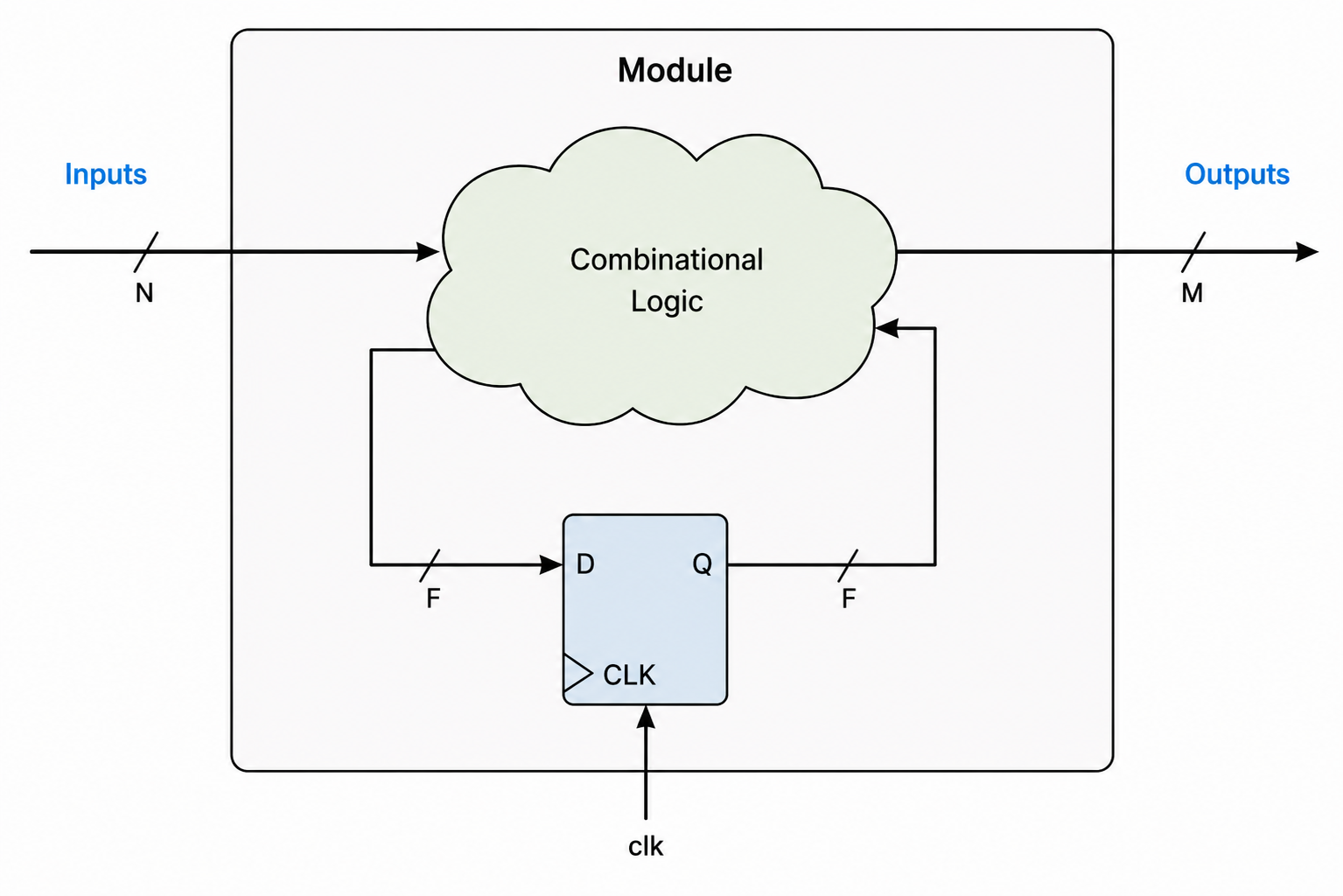
Just two components:
- A set of registers: these are the elements holding the state (flops, latches). They interact with the async signals (clocks, resets), and with the sync signals via its data port
- A transfer function: has as inputs the module inputs and the registers outputs, and as outputs the module outputs and the flops inputs. This single logic function describes the behavior of the whole system.
By defining just these two elements we can implement any digital block: complex DSP systems, advanced NoCs, SoCs with millions of flops. These are the two elements we need to define
If this sounds suspiciously simple, that's because it's not a new idea: this is just a Mealy machine, formalized decades ago in automata theory. Turns out reinventing the wheel is sometimes a good idea when the wheel was actually good.
A minimal IR for Synthesizable RTL
Given we can model any Synthesizable RTL block with a mealy machine, a minimal IR should "just" hold these two elements, and nothing else. Everything else we can build is an upper layer over these basic elements.
Some of the current IRs for synchronous hardware (CIRCT, FIRRTL) contain many primitives that are above this minimal Mealy layer. For example, FIFOs and Memory ares modeled, with concepts such as FIFO depth or memory size, signaling protocols (FIFO empty/full, read/write protocols) and read/write latencies being incorporated. On a minimal IR, none of these concepts exists, since we are just working with registers and the transfer functions connecting them. The details of the logic implemented by these transfer functions are not relevant. All of these concepts belong to the upper functional layer.
To make a comparison, I find an IR for synthesizable RTL having a primitive for a FIFO being equivalent to an IR for programming languages having a primitive for writing contents to a file. The IR should focus on the basic primitives that allow any program (circuit) to be generated: a particular program like a file writer (FIFO) should be made up of these fundamental primitives, not be one of them.
I find the approach of keeping the IR minimal and as "dumb" as possible, and delegating the encapsulation/sharing of these concepts in a capable HDL that can handle these level of abstraction. The definition of the read/write operations, their latency and size should be able to be encoded in a generic way in the HDL itself, not in an IR layer.
Introducing Mate IR 🧉
With the idea of seeing how far I could take this, I sat down and wrote (or, more honestly, prompted Claude to write) a compiler for it.
The IR itself is exactly the Mealy machine from before: registers, and a combinational network connecting them to the module's inputs and outputs. Getting a real compiler to target that shape meant working through a few decisions the "just two elements" pitch conveniently skips over.
The combinational network ended up being a single, global graph instead of one per module. This wasn't a decision make upfront but rather a fix to a problem encountered along the way. The initial approach was to lower each HDL module independently into registers-plus-DAG, wire the modules together, and you ended up getting what looks exactly like a combinational loop at every module boundary. Merging everything into one graph across the whole design is what makes that go away.
That graph is also strictly word-level, built from a deliberately small set of operators: arithmetic (SUB, ADD, MUL), muxing and slicing, and bitwise ops (AND, OR, XOR). Every one of them has an obvious bit-level lowering, nothing "clever" is representable at this level. Keeping the operator set this small keeps the DFG easy to analyze and has an obvious lowering path for synthesis.
Parametrization was one of the SystemVerilog features that was much more work than it had any right to be. Parameters are resolved entirely at compile time, so nothing survives into the IR except baked-in constants, but computing them correctly meant writing something close to a small expression evaluator inside the compiler. "Just substitute the values in" turned out to be doing a lot of hiding.
Making clock domains global instead of local labels also took way more work than expected, but it payed off immediately: once every register's clock is resolved to a small set of unique global clocks, the crossing points, the registers where one clock domain hands off to another, just fall out of compilation. No separate CDC tool was needed for this, it was a fact obtained early in the compilation process.
Of course we can't move forward with whatever crossings we find. In this initial compiler version, you have to provide a file "waiving" each crossing as intentional, at the same level of hierarchy as the design itself, or compilation simply doesn't proceed. It's a blunt mechanism for now, just a declared list of valid crossings, but it's already enough to move CDC from something you check for after the fact to something you have to state up front. The natural next step is a static tool that actually reasons about the IR and validates whether a given crossing is safe, instead of just trusting the waiver. But even without that yet, the shift in when you're forced to think about timing intent, at the start of writing the RTL instead of somewhere in signoff, is the part I care about most.
After compiling smaller designs and a handful of small cores off GitHub, the real milestone was getting Ibex Core to compile. It's a real RISC-V core that leans hard on packages, typedefs, and parametrization. Getting it compiled into Mate IR showed that a Mealy machine was truly all we need!
Current status
The SystemVerilog compiler handles a pretty complete slice of the language at this point: unpacked arrays, enums, structs, interfaces, parametrization, functions.
On the consumer side there are two things working today. A simulator, which codegens a C++ model from the resolved IR and wraps it in a small SystemVerilog shim called over DPI, so it can be dropped straight into any existing SystemVerilog testbench. And a static analysis tool that, for now, just reports the hierarchy of registers referencing each global clock. It's a basic shell more than a checker, but it's built directly on the clock resolution described above, so the real static checks, the ones that would replace the waiver file entirely, have a clean foundation to be added on top of.
Summary
What started some months ago as seeing how far I could take an idea with a coding agent on my command, ended up being a pretty complete IR for synthesizable RTL. It is far from being complete or actually useful but it's a nice simplification over several facts that are currently over complicated.
If any of this is useful or interesting to you, the repo is at github.com/miguel9554/mateIR. Try to run it on some design you have, report any errors, tell me why do you think this is bad (or good!). I'll be writing more about the internals of the IR and the most complicated parts to get right.